Advantages of Automated Visual Inspection Over Manual Checks
The advantages of automated visual inspection over manual checks, where people still do better, and how plants split the work between inspectors and AI.
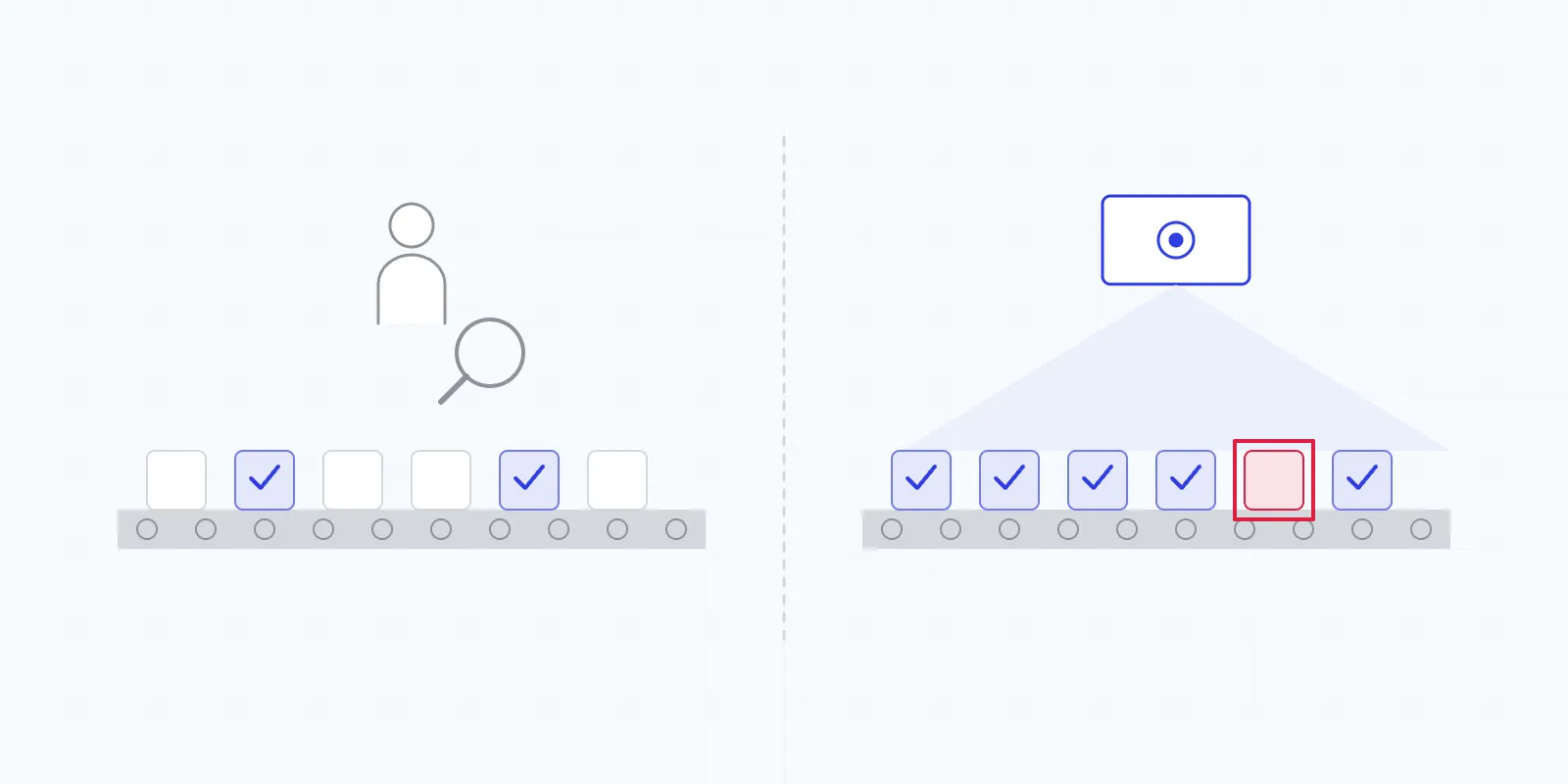
The advantages of automated visual inspection over manual checks come from one difference: a camera looks at every unit the same way, and a person can’t. Inspectors are good at judgment and bad at repetition. An AI station is the opposite. Most of the benefits, and most of the limits, follow from that.
Below, the advantages are set out one by one with the mechanism behind each, followed by the jobs people still do better and the way most plants split the work.
Where manual inspection runs out
Manual visual inspection is usually the first line of defense, and it’s not a bad one. An experienced inspector knows the product, notices things nobody wrote down, and can ask why a defect is appearing. The trouble is the task itself.
Looking at near-identical parts for hours is something human attention handles poorly. Rare defects are the hardest to see, precisely because the inspector rarely sees one. Judgment shifts between people, between shifts, and late in a long run. And at line speed, inspectors sample: they pull a part, watch a section of web, and trust the rest.
None of that is a criticism of inspectors. It’s a mismatch between the job and how people work.
Advantages of automated visual inspection, one by one
Every unit, at line speed
A camera station doesn’t sample. It images every part, or the full width of a moving web, at the speed the line runs. Defects that would have passed between two manual checks are seen. That’s the single biggest change, and every other advantage builds on it.
The same standard on every shift
The model applies one definition of each defect, with the same limits, at the start of the night shift and the end of it. Customers stop seeing quality that depends on who was at the station. When the standard changes, it changes everywhere at once.
Defects caught while they’re being made
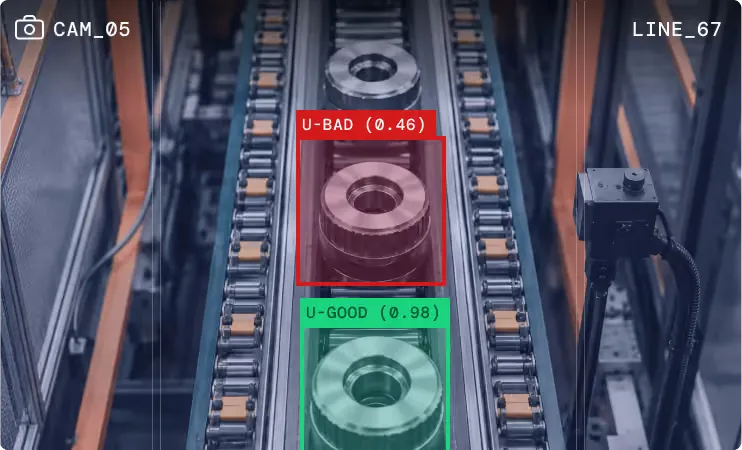
A person finds a defect and tells someone, eventually. A station raises an alert on the first bad unit, with the image, and can drive a reject gate or a flagger through the PLC. The difference shows up in scrap: a die, a seal bar or a setting gets fixed after a few bad parts instead of a full bin or roll.
A record of what was checked
Manual inspection leaves a tally sheet, if that. An automated station logs the type, location, size and time of each defect against the lot. When a customer claims a defect, the plant can check whether that lot shipped with it. It also gives process engineers trend data they’ve never had.
Fewer false rejects than rule-based cameras
This one is specific to AI. Older automated systems used fixed rules, and on glossy, textured or variable surfaces they rejected good parts often enough that operators learned to override them. A trained model separates real defects from glare, oil and normal variation. AI vs. rule-based machine vision covers that difference in depth.
People move to work that needs them
Inspection is a cost that adds no value by itself. When a station handles the looking, inspectors move to reviewing exceptions, fixing causes and running other checks. That’s headcount efficiency, not headcount cuts, and the headcount efficiency page shows how plants plan the move.
Manual vs. automated visual inspection at a glance
| Manual inspection | AI visual inspection | |
|---|---|---|
| Coverage | Samples or partial view | Every unit |
| Consistency | Varies by person and shift | Same standard every time |
| Speed of response | When someone notices and reports | On the first defective unit |
| Record | Tally sheet or none | Image, type, location, size and time per defect |
| Variable surfaces | Depends on the inspector | Handles normal variation |
| New, never-seen defects | Good at noticing | Flags anomalies for review |
| Deciding what a defect means | Strong | Needs a person |
| Cost profile | Ongoing labor on every shift | Up-front setup, then low running cost |
What people still do better
Automated visual inspection is weaker in a few places, and a fair comparison has to say so.
- Judgment on the unfamiliar. A model flags an anomaly. A person decides whether it matters, whether the customer cares, and whether it’s a new defect class.
- Defects a camera can’t see. Subsurface cracks, internal voids and wrong chemistry need other sensors or tests, and so do checks that need touch or sound.
- Very low volumes. A part made a few times a year rarely justifies a station. A trained inspector, perhaps with a camera to document, is often the right call.
- Changing the standard. Deciding what counts as a defect is a quality decision. Tristar’s process keeps that with your quality team.
Semi-automated visual inspection: how most plants split the work
The practical answer is rarely “all manual” or “all automated”. It’s a split:
- The station screens every unit and handles the clear passes and the clear rejects on its own.
- Borderline cases and new anomalies go to a review queue.
- A person decides on those, and the decisions feed back into the model in a regular review.
- Inspectors who used to watch the flow handle the queue, root cause and the checks the camera can’t do.
Over time, the review queue shrinks as the model learns your standard. The person stays in the loop for judgment; the camera handles the repetition. What AI visual inspection is walks through how a station fits into that loop.
A decision rule
Automate a visual check when it’s repetitive, high-volume and expensive to miss, when a camera can see the defect, and when a result can trigger an action. Keep it manual, or semi-automated, when the volume is low, the judgment is new or the defect is hidden.
To see what this looks like in money, the steel stamping case study shows the labor side of one deployment, and scrap reduction in manufacturing explains how inspection data turns into lower scrap. If you’re ready to compare vendors, start with the buyer’s checklist.
Frequently asked questions
Is automated visual inspection more accurate than human inspectors?
On the defects it's trained for, a well-set-up AI station is more consistent than people, because it doesn't tire, rush or drift between shifts. People are still better at judging something they've never seen before and at deciding what a new defect means for the customer, which is why the review of borderline cases stays with them.
Does automated visual inspection replace inspectors?
Usually it changes their job. Plants move inspectors from finding defects to fixing the causes, reviewing what the system flags and handling the checks a camera can't do. Headcount on the inspection station drops; the people often move to other work in quality or production.
What is semi-automated visual inspection?
A setup where the camera and model screen every unit and a person makes the final call on the parts the system flags or isn't sure about. It's a common starting point and often the long-term arrangement for high-value or low-volume products.

Our engineers design and deploy AI inspection systems on plastic film, injection molding, metal stamping and automotive assembly lines across North America.