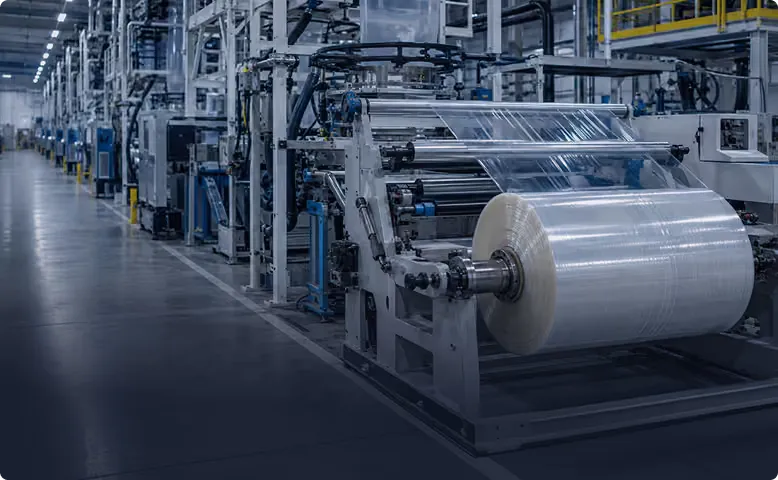











A web inspection system has one job that sounds simple: look at every square inch of a moving web and remember what it saw. Film, sheet and roll goods don’t come in parts you can pull and examine. A defect is a position on a roll that may run for miles, and by the time anyone unwinds it, the customer is the one doing the unwinding.
Tristar inspects the web inline, at production speed, across its full width. It names each defect, logs where it is, and tells the line before a short contamination event becomes a whole roll of claims.
Why roll goods are hard to inspect by eye
An operator at the winder watches a band of web for as long as attention holds, and only the side facing them. Defects that matter are small next to the web, and a lot of them only show at the right angle to the light. Pulling a sample from the tail of a roll says nothing about the middle.
Older inline web inspection solved the coverage problem with thresholds: anything darker or brighter than the background gets flagged. That works on plain clear film. It gets noisy on printed web, on film whose gauge and haze shift during a run, and on material where a harmless gloss change looks like a defect to a pixel counter. Operators learn to ignore the alarms, which defeats the point.
How AI web inspection works on a moving line
Image the full width
Line-scan cameras span the web and build a continuous image row by row. Lighting is set up in the lab for your material before anything is mounted.
Classify each defect
An edge server next to the line runs a model built on a foundation model that understands materials. It looks past gloss, haze and background and decides what each mark is.
Act on the line
The PLC fires a flagger or edge marker, and the operator gets an alert while the cause is still at the die, the screen pack or the winder.
Write the roll record
Each defect goes into the roll map and roll report with its position, size and time.
Classification is what separates a useful system from a noisy one. A gel and a carbon speck have different causes and different fixes, so they shouldn’t arrive as the same red dot. How AI defect detection works follows a single defect through that loop.
Roll maps and roll reports
A roll map lays the roll out flat with every defect drawn where it sits. Charts on top of it show defects by location across the width, by size and by time. Patterns jump out: a lane that keeps throwing gels points at the die, a burst at one timestamp points at a screen change.
The roll report is the document that leaves with the roll. Tristar tracks width, material type, roll identification and the defect history, and the layout is built around what your quality team and your customers ask for. When a claim arrives, finding the roll and the stretch in question is a lookup.
| Decision | Without a roll record | With a Tristar roll map |
|---|---|---|
| A defect burst mid-roll | Scrap or downgrade the roll | Cut out the affected stretch |
| Customer claim on a delivered roll | Argue from samples | Show position, size and time |
| Recurring defect in one lane | Found after several claims | Visible on the charts during the run |
| Slitting plan | Based on hope | Based on where the defects are |
Placement, footprint and flaggers
The station is designed around your line, not the other way around. Cameras are an array chosen for web width, speed and the smallest defect you need to catch. If the material changes as it travels, say before and after orientation or treatment, cameras can go at more than one point so you get full coverage. Tristar keeps the footprint small and shows the layout in the proposal.
Flaggers and edge markers are a common request: the system sees a defect and tags the edge of the web so the rewinder can find it. That works, and it needs some hardware design so the flag lands at the right place on your line. The same PLC outputs can drive a reject or a stop when that makes more sense.
Processing stays on an edge server in the plant. If your IT team wants the detail, edge AI for quality inspection covers the architecture.
Film is where we’ve proven it
A flexible packaging producer runs Tristar web inspection on four high-speed film lines, catching contamination, seal bar defects and gusset irregularities. Scrap fell 25% and customer claims fell 50%. The plastic film inspection page goes deeper on that industry and its defect types.
Other roll goods follow the same pattern, but we’ll tell you what the system can do on your web after we run your material. Send good and bad samples and we’ll start in the lab.