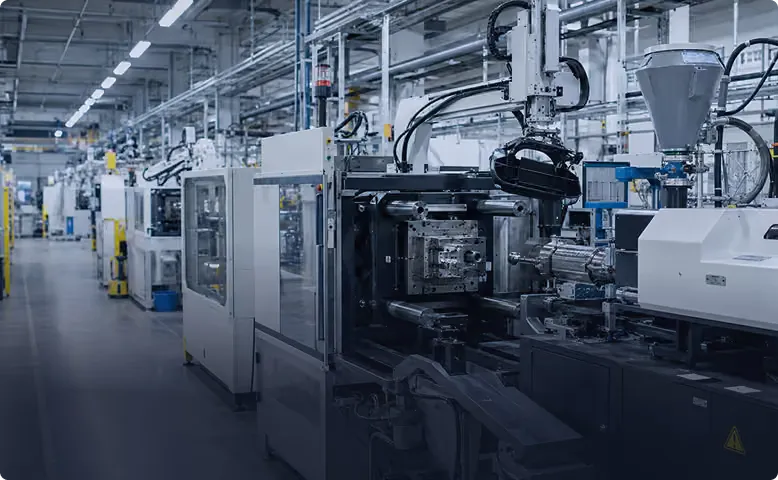











Injection molding defect detection AI watches the parts a press makes, shot after shot, and decides whether each one is good. It’s built for the defects that molding actually produces: flash at the parting line, short shots, gas burns, flow lines and color that wanders away from the master. When something goes wrong, the press team hears about it while the cause is still in the tool or the dryer.
Tristar designs the station around your press cell: cameras and lighting, an edge server, the models and the signals to your PLC, robot or reject gate.
Why molded parts are hard to inspect by eye
A molding cell makes the same part thousands of times, and the defects are often faint. A short shot can be a corner that didn’t quite fill. Flash can be a thin fringe you only see when light hits it at an angle. A gas burn on black plastic is dark on dark.
People inspecting at the press do their best, but attention fades on a fast cycle, and a busy operator is also loading inserts, clearing jams and boxing parts. Rule-based vision helps on clean geometric checks and struggles when gloss, texture and color shift between lots of resin.
Molding defects the AI is trained on
| Defect | What it usually points to |
|---|---|
| Short shot | Fill problems: material, temperature, pressure or a blocked vent |
| Flash | Parting line wear, clamp force or too much pressure |
| Gas burn | Trapped air at the end of fill, vents that need cleaning |
| Flow lines | Melt or mold temperature, injection speed |
| Discoloration | Color dosing, contamination or degraded material |
The table describes typical causes, not a diagnosis. The model tells you which defect it found, where on the part and when. Your process engineers decide what to change, with a defect history that makes the decision faster. The injection molding defects guide walks through each defect with more detail.
How molded part inspection runs in the cell
Present the part
Parts arrive on a conveyor or in a robot gripper. The station is designed for the way your cell already moves parts, including flipping a part when the critical face points down.
Image it
An array of 2D cameras, usually two or three per station, covers the faces that matter. Lighting is chosen to control gloss on shiny resins.
Decide
An edge server runs the model on each image and checks the result against the tolerance you set for that defect and that part.
Signal
A reject goes to the PLC, robot or kick-off system. An alert goes to the operator screen with the defect, the part and the suggested change.
Color is a special case. When the system sees discoloration trending, that signal can feed color pump recalibration, so dosing gets corrected from the inspection data rather than from a person comparing parts against a master plaque.
Plastic part defect detection on difficult resins
Black, translucent and glossy parts break simple vision. Tristar’s models start from a foundation model that already understands materials and looks past reflections, background and opacity. Lighting does part of the work, the model does the rest. If your parts are the kind other systems have struggled with, that’s the case worth testing first, and AI vs. rule-based machine vision explains why the approach differs. The reflective surface inspection page covers the optics in more depth.
Getting a press cell live
A high-mix molding plant shouldn’t start with every mold. Start with the parts and defects that cost the most, often your highest-volume part or the one behind the latest customer complaint.
- Send about twenty good and twenty bad parts. We run lab tests to find the lighting and camera setup, then show what the model catches.
- We design the station for your cell and keep the footprint small. You see the layout in the proposal.
- Tristar handles labeling and training. Your quality team validates the edge cases.
- After go-live, active learning flags new anomalies and a short weekly review sets tolerances, so the press team isn’t flooded with false alarms.
When a new mold or SKU arrives, the model’s knowledge transfers. Each SKU keeps its own logic, and your engineers can add inspection points with a handful of images. For what the whole loop looks like on one part, read how AI defect detection works.
We won’t promise results on your parts before we’ve run them. Send the samples and we’ll tell you what we found.