










Vision AI for manufacturing gets sold as software, and the model does matter. But most of the failures we hear about on sales calls start before the model ever sees a frame: the wrong camera for the defect size, lighting that turns a glossy part into a mirror, or a station that can’t see the face of the part that matters.
So Tristar treats the AI camera system as one design problem. Optics, lighting, part handling and compute get chosen together, per station, for the defect you’re trying to catch.
Resolution comes from the camera, so we pick the camera last
The first question isn’t “which camera do you use.” It’s “what’s the smallest defect you need to catch, and how wide is the field of view?” Those two answers set the pixel size, which sets the camera and lens. Cameras get more expensive as the defect gets smaller, or when the job involves measurement, and we say so up front.
Typical stations look like this:
- Discrete parts: an array of 2D area cameras, usually two or three per station. Round parts use the rotation the line already has, or we add a rotation stage.
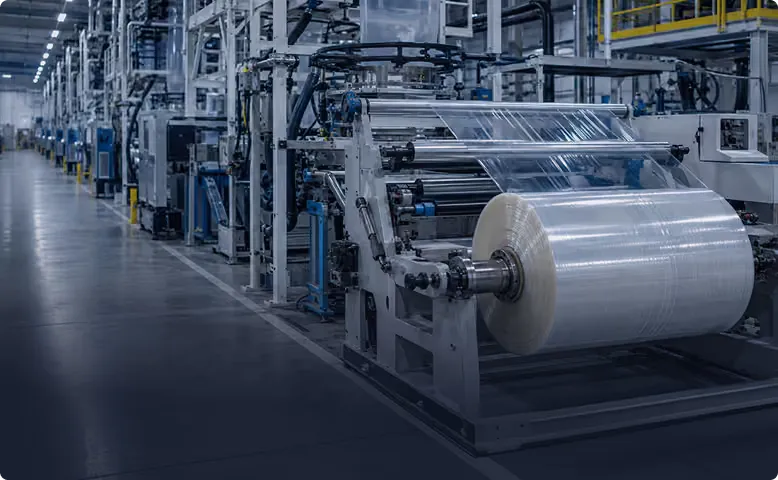
- Moving webs: line-scan cameras across the full width of film or sheet.
- Parts that change along the line: cameras at several points so each stage of the product is covered.
If cameras are already installed, we’ll evaluate running on those before proposing anything new.
Lighting does half the work
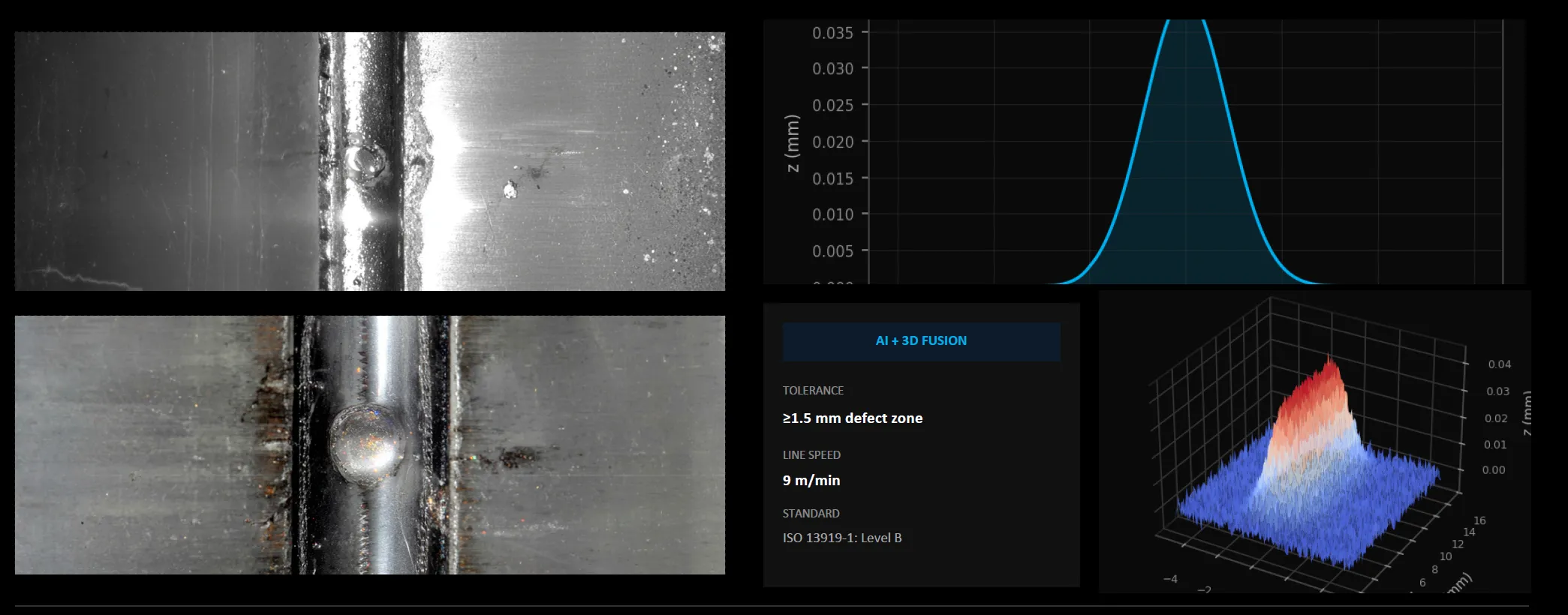
Reflective, clear and oily parts are where rule-based systems usually fall down. Our approach is to fix as much as possible in the optics first. Tristar runs your samples in the lab, tests lighting and camera setups to reduce noise, and uses specialized lighting bars that cut gloss. Then the foundation model, which already looks past reflection, shadow and opacity, separates real defects from what’s left.
Reflective surface inspection goes deeper on glossy, clear and black-on-black parts.
How the AI vision system makes a decision
Trigger and capture
The PLC or an encoder tells the cameras when a part or web section is in place, and each camera grabs its frame.
Inference on the edge
A GPU server next to the line runs the model, outlines each defect and checks it against your tolerance.
Signal
Pass or fail goes to the PLC for the reject gate, flagger or robot, and an alert goes to the operator.
Record
Image, location, size and time are stored and tied to the lot for claims and audits.
Everything runs inside the plant. Nothing needs to go to the cloud, and the station keeps working on a network that allows no outbound traffic at all. Tristar’s security and architecture packet has been through a large-company IT review, and IT usually wants it early. The edge AI guide explains the architecture.
Handling the part, not only imaging it
A camera can’t inspect a face it can’t see. Parts come off a press in any orientation, and the model handles that. When the face that matters lands down, the conveyor can be set up to flip the part. Vibration or spread conveyors help when parts overlap. These are station design questions, and they get answered on site with the part in hand, not on a call.
Footprint gets the same attention. Space beside a press or over a film line is rarely spare, so the station is laid out to fit what’s there and shown in the proposal before anything is ordered. When integration with a reject gate, flagger or robot is part of the job, Tristar’s engineers scope the hardware with whoever owns that equipment on your side.
Industrial defect detection AI camera vs. a smart camera
A smart camera bundles a sensor, a small processor and a rules editor in one housing. It’s fine for presence checks and simple measurements on a stable part. An industrial defect detection AI camera system separates the jobs: industrial optics chosen for the defect, and a GPU server with enough compute for a learned model on every frame. That’s what lets it handle variable, textured and glossy surfaces. For the longer comparison, read AI vs. rule-based machine vision.
In a steel stamping deployment across seven press lines, a system built this way reached 98% detection accuracy and paid back in three months. Your optics will differ. Send us about twenty good and twenty bad parts, and we’ll come back with the camera, pixel size and lighting that fit them.