










Turnkey factory automation usually means an integrator who takes a whole cell or line from concept to commissioning. Tristar does the same thing for one piece of the plant: the inspection station. We design it around your product, build it, install it, connect it to your PLC and hand it over working.
That scope is deliberate. Inspection is where optics, lighting, mechanics and AI models have to be right together, and splitting it across four vendors is how projects stall.
What turnkey covers here, and what it doesn’t
Covered: everything between the product arriving at the station and the reject decision reaching your equipment. That includes the camera and lighting design, any part handling the inspection needs, the edge server, the models, the PLC integration, alerts for operators and the records for quality.
Not covered: the rest of the factory. We don’t build presses, molding cells or packaging lines, and we don’t act as the plant’s general automation integrator. If you’re running a larger automation project, the station slots into it, and we coordinate with whoever owns the line controls. For how the reject loop itself works, see manufacturing process automation.
Inside an automated inspection station
Every station is different on the outside. The parts list underneath is consistent.
| Element | What it does | How it’s chosen |
|---|---|---|
| Cameras | Image every part or the full web | By the smallest defect you need to catch and the field of view |
| Lighting | Makes the defect visible and suppresses gloss | By surface finish and material |
| Part handling | Presents every surface to the cameras | By part shape and how parts arrive |
| Edge server | Runs the models in the plant | By frame rate and camera count |
| Models | Decide good or bad and locate the defect | Trained on your samples |
| PLC integration | Turns the verdict into a reject, a mark or a robot move | By the equipment already on the line |
Hardware is standard industrial equipment on purpose. When a camera needs replacing years from now, you’re not tied to a proprietary part.
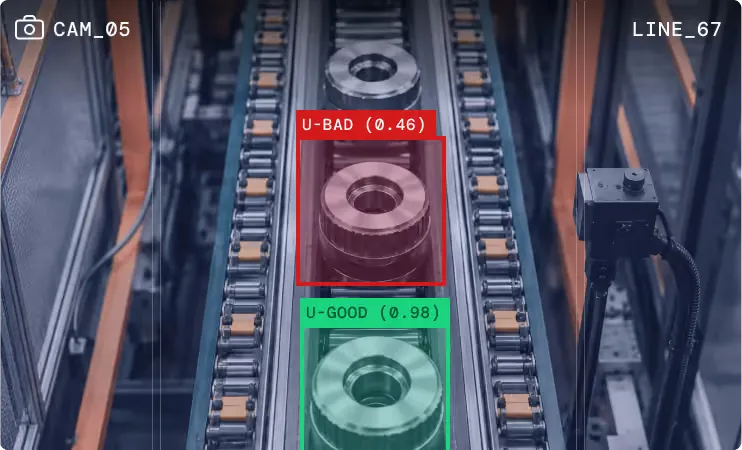
The part decides the mechanics
A camera can only judge what it can see, so much of the design work in a turnkey inspection station is about presentation.
Round parts need their whole circumference imaged. If the line already rotates them, we use that. If it doesn’t, we add a rotation stage. Two-sided parts get flipped by the conveyor design so both faces pass under a camera. Parts that arrive in a pile or overlap each other are separated with vibration or spread conveyors before they reach the field of view.
Shiny materials are a lighting problem first. Specialized lighting bars cut the glare, and the model handles what’s left: it’s built to look past reflections, shadows and gradients and focus on the material. Metal surface defect detection shows what that looks like on steel.
How delivery of the turnkey solution runs
Scope the part and the defects
You send samples and defect definitions. We run them and report what the model finds and what the station would need.
Design the station
Camera positions, lighting, handling and the reject interface are laid out for your line and reviewed with your engineers.
Train the models
Tristar labels the images and trains. Your team checks the borderline cases, because they know which ones a customer would send back.
Install and integrate
The station goes onto the line, and its signals are wired to your PLC and reject equipment.
Calibrate and document
A calibration report records how the station performs at install. It's the baseline for later audits.
Train and hand over
Operators and plant engineers are trained. A weekly review after go-live sets tolerances and adds defect types.
We don’t put durations on these steps here because they depend on the part. A flat panel on an existing conveyor is a different job from a round, glossy part that needs its own handling.
Before you sign with anyone, it’s worth reading how to evaluate an AI visual inspection system. The questions there apply to us too.
What you provide
Turnkey doesn’t mean hands-off. The station is only as good as the definition of “defect” it’s given, and that knowledge lives in your plant.
- Samples. Good product and bad product, including the borderline pieces your inspectors disagree on.
- Defect definitions. What each defect is called, and how big or how frequent it has to be before the part is rejected.
- A line contact. One person who knows the process, can arrange access and can answer questions while we design.
After that, the station doesn’t have to cover everything on day one. Plants with many SKUs start with the part and defect combinations that cost the most, and extend from there. Knowledge transfers between products, so each addition is smaller than the first. The inspection approach itself is described on the AI visual inspection page.
What a finished station returned in steel stamping
A steel stamping operation runs Tristar stations on seven press lines. Manual four-eye checks used to take two operators 80 hours per month per line; now one operator manages that workload. Detection accuracy is 98%, scrap is down 25% and the project paid back in 3 months. The case study is public.
We can’t promise those figures on a different part. Send samples, and we’ll tell you after we run your parts.